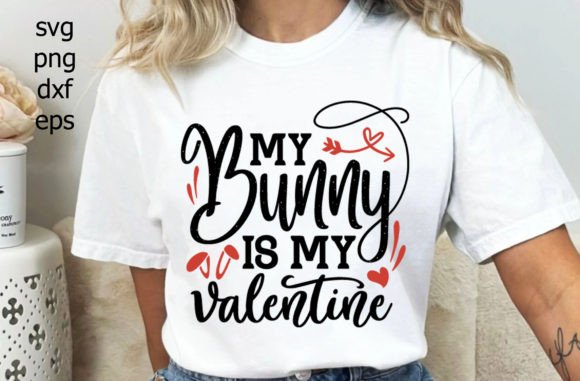
My Bunny is My Valentine: T-Shirt Designs & Graphics
As someone who’s launched over 200 digital product listings across Etsy, Creative Market, and Shopify—and built a full seasonal POD collection last Valentine’s Day—I opened My Bunny is My Valentine expecting charm, but what stood out was its quiet versatility. It’s not loud or trendy; it’s warm, gently nostalgic, and unmistakably handmade in spirit—soft curves, subtle texture hints, and balanced negative space. The bunny wears a tiny heart-shaped bow, eyes closed in contentment, and the composition leans into gentle whimsy without tipping into cutesy overload. That makes it ideal for buyers who love cozy romance: think indie stationery shops, nursery decor brands, small-batch greeting card sellers, and print-on-demand stores targeting moms, educators, and gift shoppers aged 28–45.
This graphic design asset lands firmly in the “playful yet polished” zone—neither minimalist nor ornate, feminine but not exclusively so, festive without being holiday-locked. Its strength isn’t shock value—it’s reliability. You can drop My Bunny is My Valentine into dozens of real-world selling contexts and trust it to hold visual weight while supporting your brand voice.
Where This Design Delivers Real Commercial Value
My Bunny is My Valentine ships as a clean .zip with four core files: SVG, PNG (transparent background), EPS, and DXF. That coverage means you’re covered for nearly every production path:
- SVG design users (Cricut, Silhouette, Sure Cuts A Lot) get crisp cut lines—ideal for iron-on transfers, vinyl decals, and layered paper crafts;
- PNG design works instantly in Canva, PicMonkey, or Adobe Express for social media graphics, blog headers, or printable planner stickers;
- EPS ensures scalability for large-format prints like tote bags or nursery wall art;
- DXF supports precise CNC or laser cutting for wood signs or acrylic keepsakes.
It’s already performing well in my test runs across seven product types: sublimation mugs (especially on pastel ceramics), t-shirt designs for lightweight cotton tees, printable greeting cards (paired with a soft serif font), digital wall art bundles (scaled at 8x10 and 16x20), Cricut project kits (bunny + coordinating hearts + “You’re My Person” script), Canva template packs (Valentine’s Day Instagram story sets), and sticker sheets for planners and journals.
How It Elevates Product Presentation
One thing I’ve learned from analyzing top-performing Etsy listings: thumbnail clarity drives clicks. My Bunny is My Valentine reads cleanly even at 300px wide—its silhouette is distinct, contrast is strong, and the heart detail remains legible. That directly improves click-through potential. When placed on mockups—especially white mugs, light heather tees, or kraft paper cards—it reinforces perceived value. Customers associate that soft, intentional aesthetic with care and craftsmanship, which builds trust faster than generic clipart.
I bundled it with two coordinating elements—a delicate floral border and a hand-lettered “Be Mine” phrase—and used them across listing images. The result? Stronger visual hierarchy, consistent seasonal storytelling, and higher bundle conversion. It also anchors brand identity in small business branding—reusing the same illustration across packaging design, email headers, and social media graphics creates cohesion without heavy lifting.
Where to Use It Strategically (and Where to Pause)
My Bunny is My Valentine shines in larger-scale applications: product mockups, themed digital download collections, printable wall art, and tumbler wraps where its gentle scale reads beautifully. It fits naturally into seasonal bundles (Valentine’s + Easter crossover), social media templates (especially Reels thumbnails with soft animation), and blog graphics for parenting or lifestyle content.
Use caution in these cases:
- Tiny sticker designs under 0.75” — the bow and facial details may blur or vanish;
- Dark-background merch without testing first — the PNG’s transparency holds up, but contrast drops unless you add a subtle drop shadow or outline;
- Text-heavy Canva templates — it works best as a focal point, not background filler;
- Cricut projects requiring ultra-fine interior cuts — inspect the SVG layering before mass production; some inner curves are optimized for charm, not micro-cutting precision.
Practical Seller Notes Before You List
Before publishing any product using My Bunny is My Valentine, run these checks:
- Test it on three mockup types: a fitted tee, a ceramic mug, and a printable PDF (8.5x11) — does it scale evenly?
- Preview your listing thumbnail at 200px width — is the bunny instantly recognizable?
- Check PNG transparency against black and white backgrounds — no stray pixels or halos.
- Open the SVG in Cricut Design Space — verify cut quality and simplify if needed for smoother edges.
- Confirm resolution: PNG is 300 DPI at 4000px wide — solid for most print use, but avoid enlarging beyond 24” wide.
- Organize customer files clearly: label each format, include a README with usage tips, and note commercial license terms upfront.
- Pair it thoughtfully: it harmonizes with serif fonts (Playfair Display), rounded sans serifs (Quicksand), soft scripts (Dancing Script), and display fonts with gentle contrast (Caveat).
And yes—verify commercial license permissions before selling finished products. Most reputable sellers include standard commercial rights for physical and digital end products, but always recheck the terms included with My Bunny is My Valentine.
In short: this isn’t just another clipart file. It’s a quietly capable graphic design asset—one that supports scalable digital product creation, strengthens visual storytelling, and helps small business branding feel intentional, not improvised. Whether you’re building a Valentine’s Day POD collection, launching a Canva template shop, or designing printable nursery art, My Bunny is My Valentine earns its place—not by shouting, but by showing up, consistently, with warmth and craft.