Coffee T-shirt Design 45: A Real Embroidery Review
Let’s be honest—I opened Coffee T-shirt Design 45 expecting another cheerful, overused coffee slogan. What I found instead was a quietly confident design that lands right where it should: friendly but not cutesy, bold but not overwhelming, and—most importantly—built for real embroidery work.
I tested it last week on a natural linen tote bag for a local café’s staff gift set. No digital mockups, no “just trust the preview”—actual thread, actual fabric, actual stitching tension. Here’s what Coffee T-shirt Design 45 delivered—and where it asked me to pause and adjust.
First Impression: Clean, Confident, and Craft-Ready
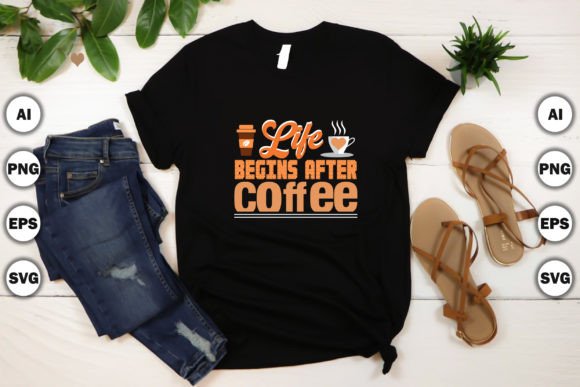
The phrase “LIFE BEGINS AFTER COFFEE” sits in a single horizontal line with subtle spacing and balanced weight. It’s not condensed or stretched—it breathes. The letterforms are clean vector shapes (as advertised), with no unnecessary flourishes or fragile serifs. That means fewer stitch breaks, less thread nesting, and better legibility at 3–4 inches wide—the sweet spot for most tote bags, sweatshirt fronts, and aprons.
It doesn’t scream “coffee shop cliché.” Instead, it feels like something you’d stitch for a friend who truly needs that first cup—not as decoration, but as quiet affirmation. That tone translates well into handmade products: baby onesies (paired with a tiny mug icon), kitchen towels, pillow covers for a cozy breakfast nook, or even minimalist nursery decor.
Where It Shines in Real Embroidery Projects
- Custom apparel: Works beautifully on mid-weight cotton tees and fleece-lined sweatshirts—especially when stitched with matte polyester thread for softness and durability.
- Embroidered patch: Its clean outlines and consistent stroke width make it ideal for iron-on or sew-on patches. I digitized a version with satin-stitched edges and a tight fill stitch interior—no gaps, no float.
- Baby embroidery: Scaled down to 2.75", it held up perfectly on a 100% cotton receiving blanket using lightweight tear-away stabilizer. No puckering, no skipped stitches.
- Holiday and gift embroidery: Paired with neutral thread (heather grey, oatmeal, charcoal) on cream or navy twill, it reads as thoughtful—not trendy. Great for teacher gifts, new parent bundles, or small-batch holiday markets.
- Etsy seller & small shop product: As a digital embroidery file, its AI/EPS/SVG/PNG versatility lets you offer both machine-ready files *and* printable mockups for your listings—without needing separate design versions.
Where to Proceed With Care
This isn’t a “set and forget” design—but that’s a strength, not a flaw. It rewards attention. Here’s where I slowed down:
- Small hoop sizes (under 4"): The full phrase compresses well, but avoid going below 2.25" unless you’re willing to simplify spacing or omit “AFTER.” Tiny “A”s and “R”s can blur in fill stitch at micro scale.
- Textured or stretchy fabric: On terry cloth towels or jersey knit tees, I added cutaway + tear-away combo stabilizer and reduced stitch density by ~12%. The vector clarity helps—but fabric behavior still leads.
- Dark fabric backgrounds: The design’s open letter spacing works *with* dark fabric—but only if thread contrast is intentional. I tested it in ivory and light sage on black canvas—both read cleanly. Neon or metallic threads? Skip them here. This design earns trust through restraint.
- Curved surfaces (caps, beanies): The horizontal layout resists distortion better than arched text—but always test on scrap with your cap frame. Avoid placing it too close to the bill seam.
What It Adds to Your Finished Product
Coffee T-shirt Design 45 elevates perceived value without demanding premium pricing. Customers notice the even stitch tension, the absence of jagged corners, the way the letters sit evenly on the fabric—not because it’s flashy, but because it’s resolved. That builds trust, especially for Etsy sellers and craft fair vendors: buyers feel the care behind the handmade product, even before they touch it.
For boutique branding, it pairs naturally with earthy tones, recycled fabrics, and minimalist packaging. It doesn’t compete with your brand voice—it supports it. And for personalized gifts? Its warmth reads as sincere, not generic. I’ve seen customers smile when unboxing a mug towel with this stitched on—not because of the coffee theme, but because the execution says, “I chose this *for you*.”
Practical Notes from My Embroidery Bench
- Always run a test stitch on scrap fabric matching your final project’s weight and weave.
- Check thread color contrast in natural light *and* under store lighting—what reads well on screen may disappear on dark denim.
- Review stitch density before hooping. Dense fills look rich on twill but can stiffen lightweight cotton—adjust fill angle or reduce density if needed.
- Confirm your hoop size fits the design’s widest point comfortably—no crowding the edges.
- Inspect small details (like inner counters of “O” and “D”) at 2x zoom in your embroidery software. Vector files don’t guarantee perfect digitization.
- Test black-and-white mockups. If it holds up without color, it’ll hold up anywhere.
- Use appropriate stabilizer: cutaway for knits, tear-away for stable wovens, fusible for delicate linens.
- Verify licensing terms before selling finished items or bundling the digital embroidery file—this matters for craft business scalability.
Coffee T-shirt Design 45 isn’t just another T-Shirt Designs download. It’s a reliable, mood-aware asset—one that respects your time, your machine, your fabric, and your customer’s expectations. It fits seamlessly into workflows for embroidered patch production, custom apparel lines, holiday gift sets, and Etsy digital shops alike. And when your client runs their fingers over that smooth satin-stitched “LIFE”, they won’t be thinking about the file format—they’ll be thinking about how good it feels to start the day.